

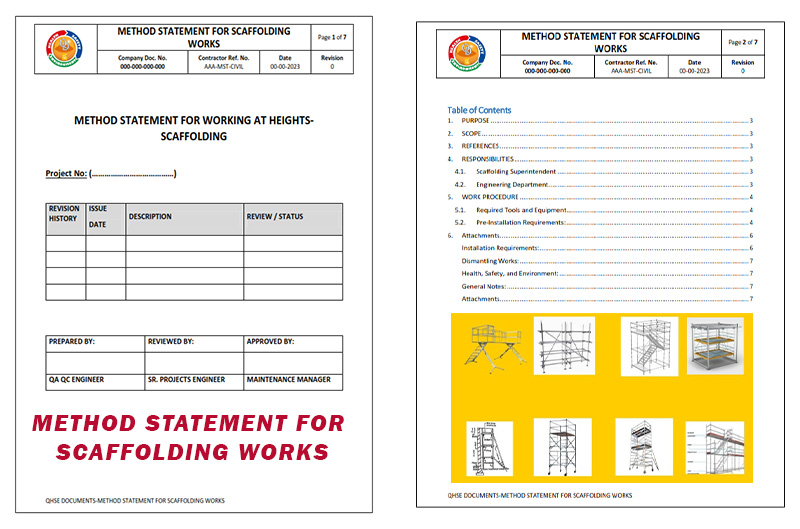
This scaffolding method statement “Method
Statement for Scaffolding Works “will enable you to know the answers about
various questions such as What is a method statement in scaffolding?
What is the procedure for erect scaffolding? Does scaffolding need Swms? What
are the safety standards for scaffolding?
free scaffolding method statement template, scaffolding installation guide pdf method statement and risk assessment
for scaffolding, scaffolding
safe work procedure, scaffolding
procedure, scaffolding
inspection procedure pdf, method
statement for shuttering work.
To download freer editable QHSE documents,
keep visiting site frequently.
Table of Contents
1. PURPOSE
2. SCOPE
3. REFERENCES
4. RESPONSIBILITIES
4.1. Scaffolding Superintendent
4.2. Engineering Department
5. WORK PROCEDURE
5.1. Required Tools and Equipment
5.2. Pre-Installation Requirements:
6. Attachments
Installation Requirements:
Dismantling Works:
Health, Safety, and Environment:
General Notes:
Attachments
1. PURPOSE
Ensure that installation/erection of scaffoldings in various locations inside the plant is carried out safely following good working practice as per General Instruction requirements. The scaffoldings shall be erected to ensure safe working access for the completion of certain identified work as a requirement.
2. SCOPE
- This method statement applies to all scaffolding installation activities regardless of type and size, which are to be installed on the [Project Name & Location].
- Moreover, an underhung scaffold shall be erected in this particular activity. Concerning the elevation or heights of the underhung scaffold, it shall be defined by the certified scaffold supervisor by the contractor to ascertain the stability and soundness of the newly erected scaffolding. The area which requires scaffolding access platforms during the erection/installation of piping materials and equipment shall commit to this Method Statement.
- [COMPANY NAME HERE] shall comply with the requirements of the [State-Country’s] Scaffold Safety Handbook.
3. REFERENCES
- [State-Country’s] Scaffold Safety Handbook
- [State-Country’s] Erection Procedure for Piping
- [State-Country’s] Scaffolding Safety Handbook
- [State-Country’s] Project Safety Manual
- [State-Country’s] Lost Prevention Department
- [State-Country’s] Standard Operating Instruction
- ·[State-Country’s] Safety & Loss Prevention Program
4. RESPONSIBILITIES
4.1. Scaffolding Superintendent
- Ensure full compliance by all scaffolding personnel and equipment operators and other associated craftsmen requirements of this method statement regarding the execution of the work following [State-Country’s] safety requirements and specifications.
- Confirm the availability of all materials, tools, equipment, and required personnel who will carry out the work. Conduct brief meetings with all personnel involved in scaffolding works and inculcate in their minds the danger and precautions of the work.
4.2. Engineering Department
- Generate relevant drawings, load calculations & method statements, following project specifications, and HSE requirements, and submit to the client for review and approval.
- Provide technical support to [Contractor/Company] site operation group. Scaffolding Inspector
- Monitor daily scaffolding activities and ensure that all erected scaffolding is safe to use as working access, and also safe to use as temporary pipe supports for fit-up purposes of piping works if necessary. Identifies all types of scaffolding approval and is well versed in all aspects of scaffolding (red, yellow, and green) tags certified by [Contractor/Company] Safety Supervisor or Scaffold Supervisor:
- Ensure that work permits are obtained before the commencement of any work.
- Check personnel and confirm compliance with safety requirements, such as wearing personnel protective equipment.
- Check work areas for any unsafe conditions, liaised with the Field Superintendent ensuring that work is carried out following Project Safety Plan/Procedures.
- Identify hazards as indicated in HAZOP.
5. WORK PROCEDURE
5.1. Required Tools and Equipment
- Scaffolding Tubes include longitudinal bracings, sills, baseplate, universal jacks & personal protective equipment.
- Scaffold Planks (Boards) – Swivel and Fixed Coupler/Wrap-over Coupler
- Ladder/Ladder Clamp
- Wrenches/Spanner – Scaffolding Tags (Red, Green, and yellow)
- Caster Wheel
- Ropes & canvass bucket
- Wire ropes (for wire lashing)
- PPEs (Full Body Harness, lifeline/ lanyards, easy tie-off anchor, safety rope lanyard, soft stop protection, etc.
5.2. Pre-Installation Requirements:
- Ensure that this method statement and other relevant other documents have been approved by [Contractor/Company] before erection and ensure these approved documents are disseminated to the concerned person who will carry out the work.
- Ensure that all scaffolding materials to be used shall comply with G.I. 8.001.
- Safety Requirements for Scaffolding Erection (attached herein).
- No planks, tubes, or couplers with signs of damage shall be used on scaffoldings. Defective scaffold materials shall be readily isolated and disposed of from the work area.
- Check with plant operation the pre-designated holding area for scaffolding materials before hauling them into the plant. Confirm and verify the exact location of the holding area.
- Check and verify the location where scaffolds will be erected and ensure that only competent, properly trained, and dedicated scaffolding personnel shall be allowed to erect, modify and dismantle scaffolds. Ensure that the erection of scaffoldings shall be carried out following [Contractor/Company] project safety requirements, general scaffolding standards, and [Contractor/Company] Working Instructions.
- Barrier-off materials staging area provides holding racks to keep materials organized.
TYPES OF SCAFFOLDING THAT CAN BE ERECTED AT THE SITE:
1. Suspended (Underhung) Scaffold
2. Tower Scaffold
3. Mobile Scaffold (caster wheels with locking device).
All necessary Types of Standard Scaffold Methods of Erection:
For Suspended (underhung) Scaffold
A suspended (underhung) scaffold with wood plank will be erected and utilized for safe access for the installation of pipes. Structures shall run in sections of approximately 3 meters wide and 7 meters long. It is suspended approximately one meter below the top of the structural beams and equally spaced through the width of 10 meters.
The ladder beams shall be supported and secured at both ends via double hangers attached to the structural grab lock coupler and by load-bearing couplers at the bottom of the tube hangers. Trapeze shall be installed approximately 0.6 meters below the ladder beam to serve as secondary support in the erection, modification, and even during the dismantling of scaffolds. Personnel access and a ladder will be provided at a suitable location(s)
Other access:
A suspended (underhung) scaffold will be erected and utilized given the limited beam works from which the hanger-type scaffold can be attached (the span between beams are 6 meters).
This type of scaffold is supported underneath the boarding level by a scaffold tube connecting the outer side of the flat form to the column.
It shall be suitably spaced at locations wherein buttwelding, touch-up painting, installation of electrical and instrumentation, and other activities will be carried out.
Tower Scaffold
This type of scaffold shall be erected and utilized for the area(s) between the pipe rack and equipment/vessel for conducting welding, touch-up painting, and insulation works. This type of scaffold will consist of the following (Approximate height shall be 10.315 meters):
Sole Board or Timber Sill
At least 38mm thick by 228 mm wide timber will be laid underneath the base plate to uniformly distribute the load of the scaffold to the ground. The ground must be stable, and capable of carrying the maximum intended load without settling or displacement.
Steel Base Plates – at least 6mm x 150mm x 150mm in dimension with 50mm spigot.
A. Standard Post – must be erected resting on metal base plates and shall not be positioned on or close to pits or edges of excavations where the possibility of cave-in or soil erosion potentially exists.
B. Safe scaffoldings shall bear a visible green tag and to be re-inspected by competent scaffolding Foreman/Superintendent every (2) week. All scaffolding that is found incomplete/substandard or with hazards shall be tagged immediately with a red tag until rectified. The scope in that area is almost complete in terms of erection equipment, loop connection of piping system, and structural steels, and in that point of view we rely on the competency of our scaffolders that erected scaffolds is always Safe to use as Working Access and a Temporary Support for fit-up of the piping system.
6. ATTACHMENTS
- Job Safety Analysis (JSA) – Scaffold Safety Handbook (Typical Scaffolding Plan
- Runner (Ledger) – shall be fixed to the post by the load-bearing coupler. It shall be used for scaffold tubes.
- Bearer (Transom) – shall be fixed transversely between posts and shall be securely coupled to the posts. The coupler must be kept as close as possible but not more than 300mm offset from the post. It shall be used for scaffold tubes.
- The other remaining parts are braces, toe, board, mid and top railing, caster wheel (for mobile scaffold), and personnel access ladder
Installation Requirements:
- Copy of all approved documents (Method Statement/JSA/ Scaffold plan, if required) shall be available with Scaffold Supervisor.
- Before each erection, the scaffold supervisor, permit issuer, permit receiver, and trade supervisor should jointly inspect the specific work area to confirm the physical condition and address all necessary precautions.
- All required barriers and signs shall be installed before commencing erection works.
- Temporary overhead protection of exposed nearby plants/ instruments/valves (if any) shall be installed before erecting scaffolds.
- A certified scaffold supervisor shall oversee and monitor each erection activity throughout any scaffolding work.
- Installation sequence, inspection, and tagging shall be as per G.I. 8.001 and other [State-Country’s] Scaffolding Erection Standards.
- Any alteration/ modification of the scaffold platform shall be properly coordinated by the trade supervisor with the scaffold supervisor.
Dismantling Works:
- Before dismantling any existing scaffold platform, the responsible trade supervisor shall coordinate with other affected trade supervisors (if any) to confirm NO further use or future activity on the platform.
- Before dismantling, the responsible trade supervisor, scaffold supervisor, and permit receiver shall jointly inspect and field confirm the specific scaffold structure/ platform intended to be removed/ dismantled.
Health, Safety, and Environment:
· The work shall be executed following the approved safety action plan, and daily safe work plan. Permits shall be obtained before any commencement of the work when required. Only trained and experienced workers shall be utilized for the scaffolding work. Personal Protective Equipment shall be worn at all times.
General Notes:
- In most circumstances, and to the nature of their jobs, scaffolders/ erectors are the only persons to have the considerations for standing and traveling to the structure (if necessary). But to ensure compliance with a 100% tie-off policy use a full body harness, extension lanyard, lifeline, or anchorage point that can support a weight of at least 5,000 lbs (Load/weight shall be determined by the Manufacturer).
- Safe scaffoldings shall bear a visible green tag and to be re-inspected by competent scaffolding Foreman/Superintendent every (2) week.
- All scaffolding that is found incomplete/substandard or with hazards shall be tagged immediately with a red tag until rectified.
- The scope in that area is almost complete in terms of erection equipment, loop connection of piping system, and structural steels, and in that point of view, we rely upon the competency of our Scaffolders that erected scaffolds are always Safe to use as Working Access and a Temporary Support for fit-up of the piping system.
7. ATTACHMENTS
1.1. Risk Assessment
1.2. Permit To Work at Height